Thermal Techniques
Controlling the flame to fuse metal flawlessly.
The Jeweler's Torch
Unlike welding, which melts the parent metals together, silver and goldsmithing rely on soldering—specifically hard soldering (or brazing). This requires an alloy (the solder) that melts at a slightly lower temperature than the piece being worked on.
The bench jeweler must master the torch. Oxygen and fuel gas mix to create flames ranging from a bushy, reducing flame to a sharp, oxidizing pinpoint. The metal is heated broadly; solder will always flow toward the hottest part of the metal.
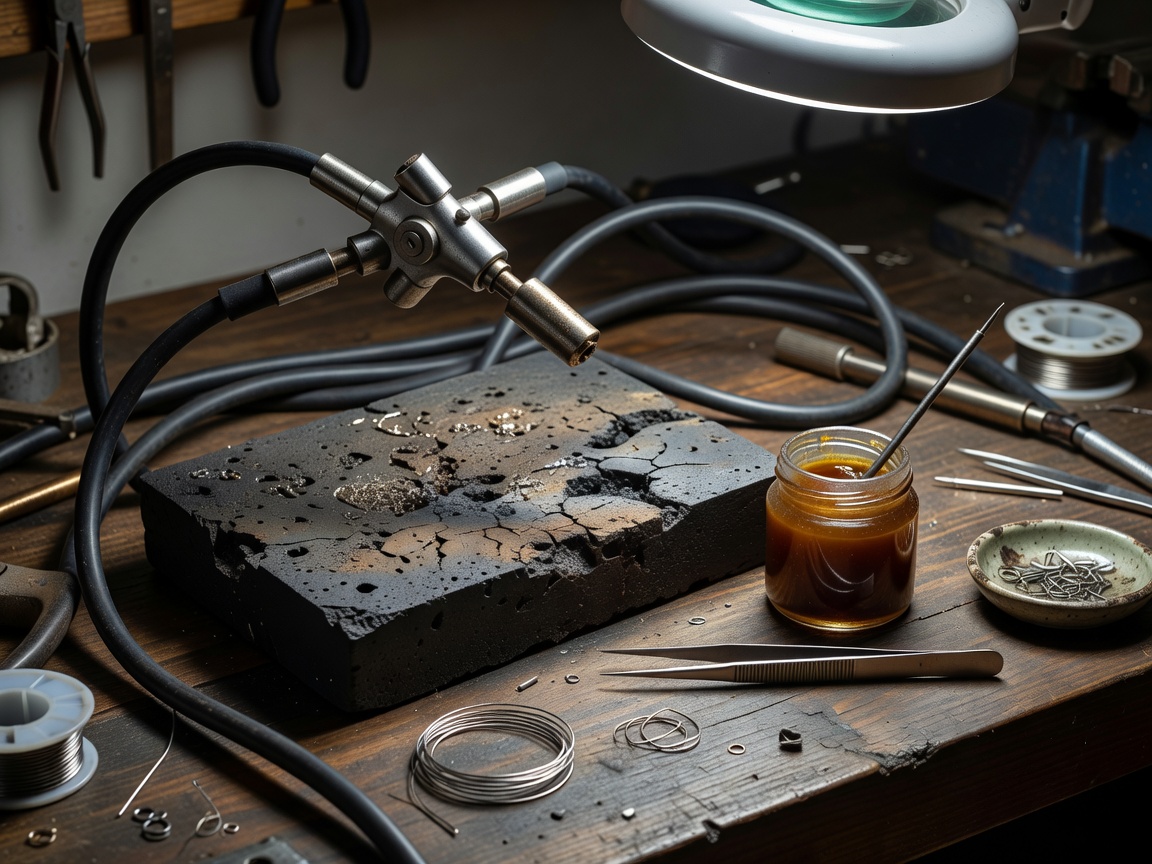
Capillary Action and Flux
For solder to flow, two conditions must be met: the joint must fit perfectly with zero gaps, and the metal must be immaculately clean. Flux—usually a borax-based liquid or paste—is applied to the joint. It prevents oxidation during heating and acts as a wetting agent, allowing the molten solder to be pulled into the seam via capillary action.
| Solder Type | Flow Temperature (Silver) | Usage Scenario |
|---|---|---|
| Hard | 1450°F / 788°C | First seams, bezel joints, structural rings. |
| Medium | 1360°F / 738°C | Secondary joints, attaching components to bases. |
| Easy | 1325°F / 718°C | Final details, delicate prongs, jump rings. |
| Extra-Easy | 1205°F / 652°C | Repairs on unknown alloys. |
The Pickle Pot
After heating, the metal is oxidized, coated in a dark scale (cupric oxide in sterling silver), and crusted with glassy flux residue. The hot piece is quenched, then dropped into the "pickle"—a warm acidic solution (often sodium bisulfate). The pickle dissolves the flux and surface oxidation, returning the metal to a matte white finish ready for the next step of fabrication or polishing.